Native Plant & Seed Glossary: Definitions for Native, Nativar & Introduced Species
Understanding what "native" really means — and how we use that word — is something we think every gardener deserves clarity on. Below you'll find our definitions for native species, nativars, introduced species, and introduced cultivars, along with how we apply each label across our catalog. For the fuller story on our approach, read our full commitment to plant transparency. Ready to shop? Browse our native plants and seeds or explore native wildflower seeds by region.
Plant Classification
Introduced Species
-
Definition: A species with a wild origin outside of the lower 48 states that has been introduced to an area within the lower 48 states where it did not occur prior to European culonization. Often referred to as "Non-native", but not to be confused with "Invasive".
-
Position: At American Meadows, we believe introduced plants can provide environmental, emotional or practical benefits and are an important part of a thriving, diverse garden. "Introduced Species" is an attribute value appearing on the PDP under the "Plant Classification" attribute.
-
Treatment for Mixes & Collections: All introduced species are assigned to "Introduced Species" under the Plant Classification attribute. Mixes and Collections containing introduced species will not be titled/labeled "Native".
-
Treatment for Individual Species: All introduced species are assigned to "Introduced Species" under the Plant Classification attribute.
Introduced Cultivar
-
Definition: A cultivated variety of a species that has been introduced to an area within the lower 48 states where it did not grow before European colonization. Synonymous with exotic, but not to be confused with Invasive.
-
Position: At American Meadows, we believe introduced cultivars can provide environmental, emotional or practical benefits and are an important part of a thriving, diverse garden. "Introduced Cultivar" is an attribute value appearing on the PDP under the "Plant Classification" attribute.
-
Treatment for Mixes & Collections: All introduced species are assigned to "Introduced Cultivar" under the Plant Classification attribute. Mixes and collections containing introduced species will not be titled/labeled "Native".
-
Treatment for Individual Species: All introduced species are assigned to "Introduced Cultivar" under the Plant Classification attribute.
Native Species
-
Definition: Plants with a naturally occurring range that included some portion of the lower 48 United States before significant European settlement.
-
Position: At American Meadows, we support the incorporation of native plants in your garden to maintain biodiversity and ecosystem health. "Native Species" is an attribute value appearing on the PDP under the "Classification" attribute.
-
Treatment for Mixes & Collections: 100% Native mixes or collections will be labeled as such. Native species will carry the attribute value "Native Species" under the "Plant Classification" attribute. As native definitions vary, please consult local resources to better understand what is considered native to your area.
-
Treatment for Individual Species: Will appear with the U.S. Native attribute (Y) and leverage Native To field in Key Features.
Native Cultivar [Nativar]
-
Definition: A cultivated variety (cultivar) of a native plant or with native plant parentage. These plants are derived from species that are native to a region that includes any portion of the lower 48 United States and have been selected or bred to emphasize specific traits for the benefit of gardeners. Also known as "Nativars".
-
Position:
At American Meadows, we’re actively strengthening the transparency and scientific scrutiny behind the varieties of plants that we offer. While the industry has traditionally treated “nativars” (cultivars of native plants) as equivalent to true native species, we recognize that some gardeners and ecological experts now prefer that nativars not be included in seed mixes or plant collections labeled as 100% native. We hear this feedback—and we agree that clarity matters.
Moving forward, we are committed to using this feedback to help gardeners make more informed decisions. This includes improving product labeling, refining how we define and categorize native species, and ensuring customers can easily understand whether a product on our site contains natives, nativars, both, or neither. As we make these updates, we’ll continue to review our existing product line to provide clearer, more accurate information.
Our goal is simple: to support gardeners and habitat-builders with products they can trust, and to uphold the botanical integrity that native gardening deserves. INTERNAL NOTE: "Native Cultivar" is an attribute value that appears on the PDP under the "Plant Classification" attribute.
-
Treatment for Mixes & Collections: Any mix whose components are a mix of native cultivars and native species will be tagged with the "Native Cultivar" attribute value under American Meadows' "Plant Classification" attribute. Native cultivars may be included in mixes and collections.
-
Treatment for Individual Species: Will be tagged with the "Native Cultivar" attribute value under American Meadows' "Plant Classification" attribute.
Blended Nativar & Native Species
-
Definition: A product which contains BOTH native cultivars AND native species.
-
Position: "Blended Nativar & Native Species" is an attribute value that appears on the PDP under the "Plant Classification" attribute.
-
Treatment for Mixes & Collections: Any mix whose components are a mix of native cultivars and native species will be tagged with the "Blended Nativar & Native Species" attribute value under American Meadows' "Plant Classification" attribute.
-
Treatment for Individual Species: This attribute value is not to be applied to single variety products.
Blended Introduced & Native Species
-
Definition: A product which contains both introduced AND native plants. This may include Native Species, Native Cultivars, Introduced Species, or Introduced Cultivars.
-
Position: "Blended Introduced & Native" is an attribute value that appears on the PDP under the "Plant Classification" attribute.
-
Treatment for Mixes & Collections: Any mix whose components are a mix of introduced (Introduced Species, Introduced Cultivars) AND native (Native Species, Native Cultivars) varieties will be tagged with the "Blended Introduced & Native" attribute value under American Meadows' "Plant Classification" attribute
-
Treatment for Individual Species: This attribute value is not to be applied to single variety products.
Other Definitions
Ecoregion
-
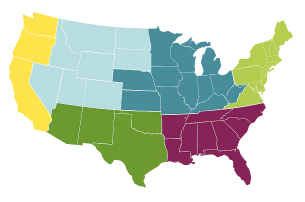
Definition: Ecoregions are based on ecological factors like climate, soil type, vegetation, and hydrology, which collectively define the natural environment. They represent a naturally cohesive area rather than artificial political boundaries.
https://www.epa.gov/eco-research/ecoregions
-
Position: American Meadows recognizes that ecoregions represent naturally unified ecosystems, which often extend beyond the limits of individual state boundaries. We believe the EPA's Level 1 and 2 ecoregions provide strong practical guidance for native planting by aligning with natural systems rather than arbitrary political boundaries. When the native range of a plant overlaps or occurs within an ecoregion, American Meadows recognizes that a plant is native within that ecoregion.
-
Treatment for Mixes & Collections: Mixes or collections linked to an ecoregion will only carry species that have a native range which overlaps or occurs within that ecoregion.
-
Treatment for Individual Species: When the native range of a plant overlaps or occurs within an ecoregion, American Meadows recognizes that a plant is native within that ecoregion.
Invasive
-
Definition: Plants that reproduce rapidly and spread aggressively from the area in which they originally occurred or were planted, posing a threat to natural area diversity, ecosystem health or managed/agricultural area productivity. This is not to be confused with "introduced species," as some native plants can become opportunistically invasive, and many introduced species do not displace others or damage local ecosystems or agriculture.
-
Position: American Meadows gathers information from trusted resources to identify plants that may be considered invasive in certain states. These products are labeled with a “Not Recommended For” notice to help customers make informed choices. Since “invasive” is not a legal classification and does not prohibit sale, these items remain available for checkout.
-
Treatment for Mixes & Collections: We do not include plants in mixes or collections designed for a geographic region in which they are considered Invasive. For national mixes and collections, we will utilize the ‘Not Recommended For’ attribute. INTERNAL NOTE: Shipping restrictions are not applied.
-
Treatment for Individual Species: We utilize the "Not Recommended For" attribute to inform customers which plants or seeds should be avoided within their state. INTERNAL NOTE: Shipping restrictions are not applied.
Not Recommended For
-
Definition: A subjective classification for plants that in a specific location are considered invasive, aggressive, or are somehow undesirable to a degree that we feel must be communicated to the customer. Does not represent any official legal/botanical status.
-
Position: American Meadows utilizes multiple resources to maintain a ‘Not Recommended For’ listing of plants that in a specific location are considered invasive, aggressive, or are somehow undesireable to a degree that we feel must be communicated to the customer. 'Not Recommended For' is an informative attribute that is displayed in the Key Features but does not block items from check out.
-
Treatment for Mixes & Collections: We do not include species flagged as 'Not Recommended For" in mixes designed for a geographic region in which they are considered Invasive. For national mixes, we utilize the ‘Not Recommended For’ attribute to inform the customer that we recommend avoiding this mix in their location.
-
Treatment for Individual Species: We utilize the ‘Not Recommended For’ attribute to inform the customer that we recommend avoiding this species in their location.
Noxious Weed
-
Definition: A legal designation for a plant considered especially undesirable, troublesome, or difficult to control in a specific location. While many noxious weeds are introduced species, each state sets its own criteria, and any plant may be listed if they interfere with agriculture or land-management goals. It’s important to note that not all plants labeled “invasive” are legally classified as noxious weeds.
-
Position: At American Meadows, we recognize that "Noxious Weed" is a legal designation that varies from state to state. A plant considered noxious in one region may be completely harmless - even native and beneficial - in another. Because these listings reflect each state's unique agricultural or land-management needs, we carefully follow all state and federal regulations to ensure that no products are shipped to areas where a species is restricted.
-
Treatment for Mixes & Collections: American Meadows does not include any plant species designated as noxious weeds by state or federal authorities in any mixes or gardens targeted to states or regions where those restrictions apply. Noxious weeds receive our "Prohibited" attribute. INTERNAL NOTE: National mixes containing Prohibited species will be marked as such on the PDP and are flagged in Acumatica and trigger a COE (Customer outreach event).
-
Treatment for Individual Species: Noxious weeds receive our "Prohibited" attribute. INTERNAL NOTE: Prohibited species will be marked as such on the PDP and are flagged in Acumatica and trigger a COE (Customer outreach event).
Prohibited
-
Definition: Listed 'Noxious' by state or federal authorities, we are legally prohibited from selling these species within a state. These products are blocked from shipment to states where prohibited. Products may be Introduced or Native.
-
Position: As ‘noxious weed’ is a designation given for various reasons and varies from state to state, American Meadows carries these with shipping restrictions. INTERNAL NOTE: This is an attribute that appears on the PDP and blocks checkout.
-
Treatment for Mixes & Collections: American Meadows does not include any species designated as Prohibited in mixes or gardens targeted to states with those restrictions. INTERNAL NOTE: National mixes containing Prohibited species will be marked as such on the PDP and are flagged in Acumatica and trigger a COE (Customer outreach event).
-
Treatment for Individual Species: The "Prohibited" attribute is assigned to all Noxious Weeds based on state designations. INTERNAL NOTE: AMC uses ACU functionality to ensure we do not ship to prohibited states.
Severe Threat
-
Definition: Species that pose a substantial ecological or economic risk due to their classification as invasive, noxious, or prohibited by a majority of states. May also be species that are not recommended for a significant portion of the states within American Meadows' shipping range.
-
Position: As the Authority in our space, these species have been permanently removed from our assortment to prevent their spread and mitigate associated risks.
-
Treatment for Mixes & Collections: As the Authority in our space, these species have been permanently removed from our assortment to prevent their spread and mitigate associated risks.
-
Treatment for Individual Species: As the Authority in our space, these species have been permanently removed from our assortment to prevent their spread and mitigate associated risks.
Noxious weeds receive our "Prohibited" attribute. Prohibited species will be marked as such on the PDP and are flagged in Acumatica and trigger a COE (Customer outreach event).
State Native
-
Definition: Plants with a naturally occurring range that included some portion within the current state boundary before significant European settlement.
-
Position: At AMC, we recognize that state boundaries are human-defined and do not align with the native ranges of plant species. When the native range of a plant overlaps or occurs within a state, AMC identifies that a plant is native within that state.
-
Treatment for Mixes & Collections: AMC recognizes that state boundaries are human-defined and do not align with the native ranges of plant species. When the native range of a plant overlaps or occurs within a state, AMC recognizes that a plant is native within that state.
-
Treatment for Individual Species: Native to attribute will list best fit to define the natural range (state or ecoregion)
AMI recognizes the following authorities as best suited to reinforce/support the definitions in this glossary: USDA, BONAP, USPTO, EPA, State Extension Services